Decision Records for AI Teams: Why Every Spec Change Needs an Audit Trail
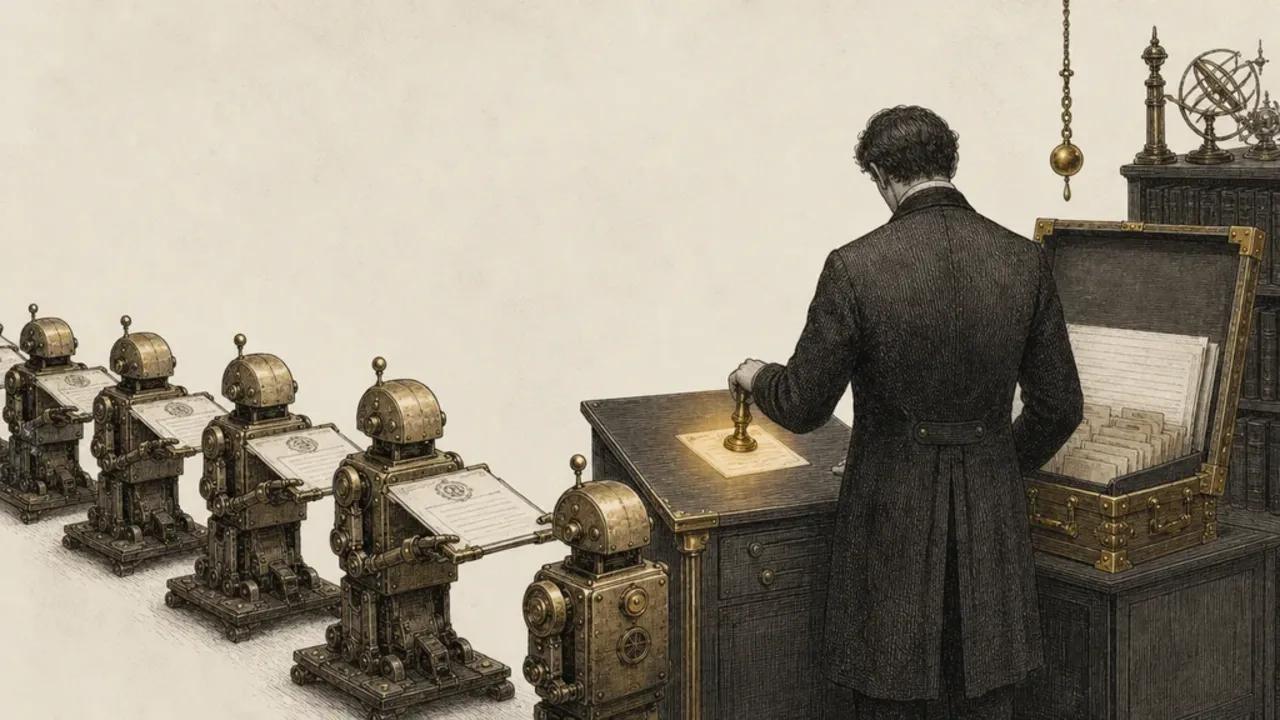
Decision records are short documents that capture one decision, why the team made it, and what it costs. For AI teams, they answer the question every spec change raises later: who proposed this, who approved it, and why?
Your agents can open a dozen pull requests before lunch, and each one carries a reason that lives only in a chat window. Six months later, someone asks why the retry limit is three, and nobody remembers because the agent's context is gone. A decision record fixes that, and it keeps the auditor happy too.
What are decision records?
A decision record is a short, permanent document that captures one decision, the context behind it, who made it, and the consequences the team accepts.
The best-known form is the architecture decision record, or ADR. Michael Nygard described it in his 2011 post Documenting Architecture Decisions. His point was simple: teams lose track of the motivation behind past choices, so new people either follow rules blindly or reverse them without knowing the cost.
Nygard's format has five parts: title, context, decision, status, and consequences. He suggested the whole document should run one or two pages. When a decision gets reversed, the old record stays and is marked superseded, with a pointer to the new one.
The community site adr.github.io defines an ADR as a record that captures a single architectural decision and its rationale. The collection of ADRs in a project forms its decision log. That log is the history of why your system looks the way it does.
How do teams use ADRs today?
ADRs moved from one consultant's blog to mainstream practice. The Thoughtworks Technology Radar placed lightweight ADRs in its Adopt ring in 2017 and again in 2018. It recommended storing them in source control instead of a wiki, so the record lives next to the code it explains.
Cloud providers wrote the practice into their own guidance. AWS Prescriptive Guidance on the ADR process walks through four statuses: proposed, accepted, rejected, and superseded. Reviewers read each ADR in a dedicated slot of about 10 to 15 minutes, then the owner works through the comments.
“When the team accepts an ADR, it becomes immutable.”
That rule matters more than any template field. You never edit history. If the team learns something new, it writes a new record that supersedes the old one, and the trail stays intact.
Why do AI agents raise the stakes for decision records?
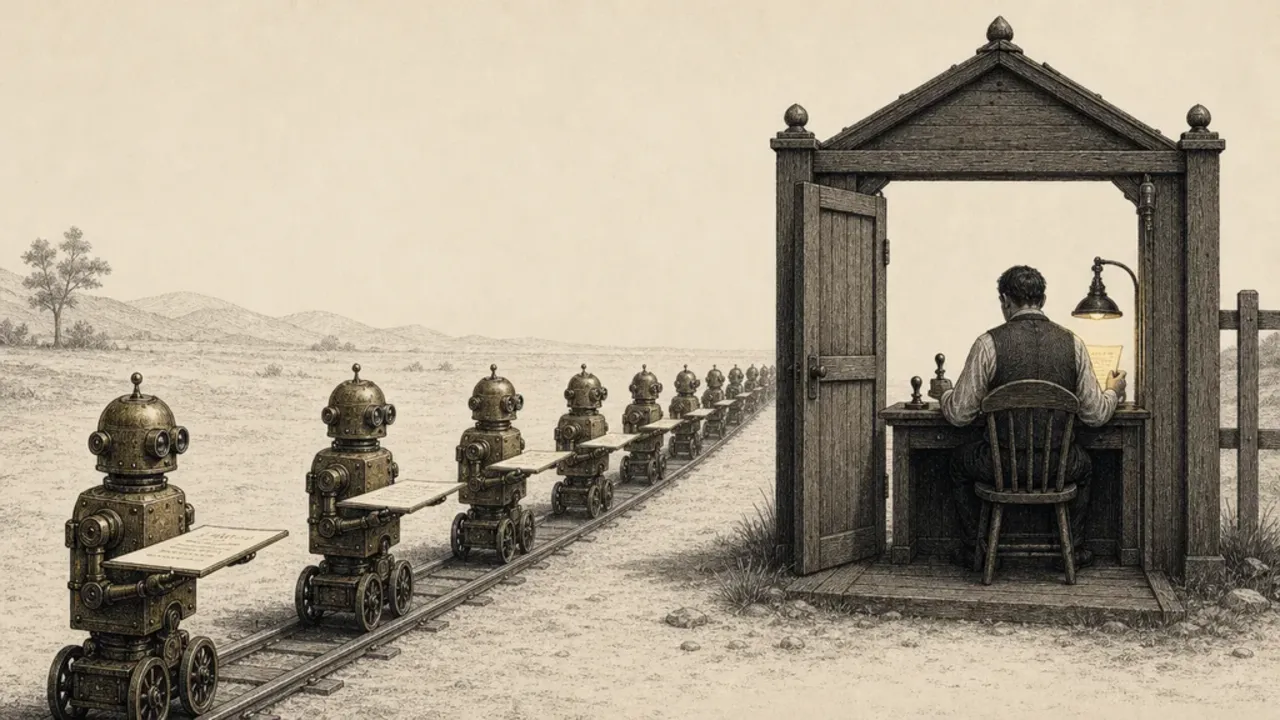
ADRs were built for a world where a few senior engineers made a few big calls per quarter. AI agents flip that math. They propose changes constantly, and the reasoning behind each one often disappears when the session ends.
Agent use is climbing fast. In a Stack Overflow pulse survey of 1,100 developers fielded in April 2026, 59% said they use AI agents at work, up from 31% in 2025. Daily use jumped from 14% to 37%.
Teams are not handing over the keys, though. The same survey found 63% rarely or never let agents run fully on autopilot, and 60% block agents from making unapproved system changes. People want agents in the loop and humans on the decision.
Trust is the reason. In the 2025 Stack Overflow Developer Survey, 87% agreed they worry about the accuracy of information from AI agents. And 66% named AI answers that are "almost right, but not quite" as their top frustration.
What happens to agent pull requests today?
Agents already ship a lot of changes to real projects. A 2026 empirical study of agentic pull requests from Polytechnique Montréal examined 9,428 agent PRs across 489 popular Python repositories. Of those, 7,293 were merged.
Merge rates varied widely by agent. Human PRs in the same repositories merged at about 85%, while model-adjusted rates for agents ranged from 43% to 84%. Several agents, notably Copilot, Cursor, and Devin, drew more review comments than human PRs, and Devin and Copilot PRs carried more commits, which the authors suggest may reflect follow-up revisions.
Every merged agent PR is a decision someone made, even if they made it in 30 seconds. Every rejected one is a decision too. Without a record, you cannot tell which reasons held up and which were guesses.
What does the EU AI Act say about record keeping?
Regulators now expect a paper trail for AI. Article 12 of the EU AI Act says high-risk AI systems must technically allow for the "automatic recording of events (logs)" over the lifetime of the system. Those logs should help identify risks or substantial modifications, support post-market monitoring, and track how the system operates in practice.
Article 14 adds human oversight. High-risk systems must be designed so people can effectively oversee them, understand their limits, and override or reverse their output. People must also stay aware of the pull to over-rely on what the system recommends.
Most coding agents are not high-risk systems under the Act. But the direction is clear: logs, named human deciders, and the power to reverse a change are becoming the baseline for AI governance audit trails. Teams that keep decision records now will not scramble later.
How is a decision card different from an ADR or a commit message?
A commit message tells you what changed. An ADR tells you why, but at one or two pages it is too heavy to write for every agent proposal. A decision card sits in between: an ADR sized for review.
Crema defines a decision card as who this is for, why we're doing this, the change, the limits, and the spec text, on one screen. A reviewer can read it, decide, and move on inside one focused session. That makes it practical at agent volume.
| Classic ADR | Decision card | Commit message | |
|---|---|---|---|
| Main question | Why did we choose this design? | Should we accept this spec change? | What changed in the code? |
| Typical size | One or two pages | One screen | One line to a short paragraph |
| Who it is for | Future engineers | The reviewer deciding now, and future readers | Developers reading history |
| Records the reason | Yes, as context and consequences | Yes, required up front | Sometimes |
| Records limits | As consequences | Yes, explicit limits field | Rarely |
| Records who decided | Often, as status and stakeholders | Yes, in the audit trail | Author only, not the approver |
| Fits agent volume | No, too slow to write and read | Yes, built for frequent review | Yes, but missing the why |
You do not have to pick one. Keep ADRs for big architecture calls, use decision cards for every spec change, and let commit messages do their job in code. Each layer answers a different question.
What should a decision record template include?
A good ADR template for AI teams blends Nygard's five parts with the fields agents make necessary. Keep every field short. If a field needs more than a few sentences, the change is probably too big for one record.
| Field | What to write | Why it matters |
|---|---|---|
| Title | A short noun phrase naming the decision | Makes the decision log scannable |
| Who it is for | The user, team, or system this change serves | Forces a real audience, not a vague goal |
| Why | The problem or evidence behind the change | Preserves the motivation Nygard warned teams lose |
| The change | What will be different, in plain words | Lets a reviewer decide without reading a diff |
| Limits | Scope, word count, tests, dependencies, and what is out of bounds | Keeps agent proposals from sprawling |
| Spec text | The exact section text being added or revised | Ties the decision to the source of truth |
| Status | Proposed, accepted, rejected, or superseded | Matches the AWS lifecycle |
| Consequences | What gets easier, what gets harder, and what you accept | Makes the trade-off explicit |
| Supersedes | Link to the record this one replaces, if any | Keeps history intact instead of editing it |

What should you log when an agent proposed the change?
Agent proposals need a few extra fields that human ADRs rarely track. The goal is an audit trail for AI agents that a new teammate, or an auditor, can read cold. Log these every time.
- Proposer: Which agent or person drafted the change, including the agent name and the human who ran it.
- Controls in effect: The agent controls active at the time, such as which sections it could change and its limits on words, tests, dependencies, and proposals per week.
- Decider: The named human who accepted or rejected the change. An agent can propose, but a person decides.
- Time: When the proposal was opened and when the decision was made.
- Reason: Why the decider said yes or no, in one or two sentences.
- Supersedes: Which earlier decision, if any, this one replaces.
This list mirrors how Crema handles it. Crema Spec keeps an append-only audit trail of who drafted, who decided, when, and why. Permissions are set per proposer in a repo file and revoked with a one-line change, so the controls in effect are themselves on the record.
| Practice | Plain ADR workflow | How Crema handles it |
|---|---|---|
| Where records live | A docs folder in the repo | One GitHub monorepo for the spec |
| How changes arrive | A new ADR file | Every new section or revision is a pull request |
| Size limit | Guideline of one or two pages | Admission check caps each change at 2,000 words |
| Required reasoning | Context section | Admission check requires who it is for and why |
| Review rhythm | Ad hoc slots | 25-minute review cycle |
| History | Superseded status by convention | Append-only audit trail |
How do you start keeping decision records on an AI team?
You can start this week with nothing but a folder and a template. The hard part is the habit, not the tooling. Follow these steps.
- Create a decisions folder in the same repo as your spec, as the Thoughtworks Radar recommends.
- Copy the template table above into a file and trim any field your team will not fill in.
- Require a record for every spec change, whether a person or an agent proposed it.
- Name a human decider on every record, and never let an agent approve its own proposal.
- Write down your agent controls in the repo so each record can point to the rules in effect.
- Treat accepted records as immutable and write a new one to supersede, never edit.
- Review the decision log once a month to spot patterns, reversals, and drift.
If your specs already sprawl, read what spec drift is and how it starts first. Decision records work best on top of spec-driven development, where the spec is the single source of truth. For the bigger picture, see how software factories run on specs.
What Is Spec Drift? Why AI-Built Software Stops Matching the Plan
How to Write a PRD for AI Coding Agents (Free Template)
When 100% of the Company Codes: How AI-Native Companies Stay in Control
Frequently asked questions
What is an ADR?
An ADR, or architecture decision record, is a short document that captures one architectural decision and its rationale. Michael Nygard proposed the format in 2011 with five parts: title, context, decision, status, and consequences.
What is the difference between a decision log and a decision record?
A decision record covers a single decision. A decision log is the full collection of records a project keeps over time. Together they show why the system looks the way it does.
Does the EU AI Act require decision records for coding agents?
Not directly. Article 12 requires automatic logging and Article 14 requires human oversight for high-risk AI systems. Most coding agents are not high-risk, but these rules show where AI governance is heading.
Should you ever edit an accepted decision record?
No. AWS guidance treats accepted ADRs as immutable. If the decision changes, write a new record that supersedes the old one and mark the old one superseded.
What is a decision card?
A decision card is Crema's term for an ADR sized for review. It shows who the change is for, why, the change, the limits, and the spec text on one screen.
Sources and further reading
- Cognitect (Michael Nygard) (2011). Documenting Architecture Decisions
- ADR GitHub organization (2026). Architectural Decision Records (ADRs)
- Thoughtworks (2018). Technology Radar: Lightweight Architecture Decision Records
- AWS (2022). Prescriptive Guidance: ADR process
- European Commission AI Act Service Desk (2024). Article 12: Record-keeping
- European Commission AI Act Service Desk (2024). Article 14: Human oversight
- Stack Overflow (2026). Agents on a leash: Agentic AI remains mostly single-agent and monitored at work
- Stack Overflow (2025). 2025 Developer Survey: AI
- arXiv (Mazloomzadeh, Morovati, Khomh) (2026). How Do AI Coding Agents Contribute to Software Development? An Empirical Study of Agentic Pull Requests
- Crema (2026). Research and bibliography